
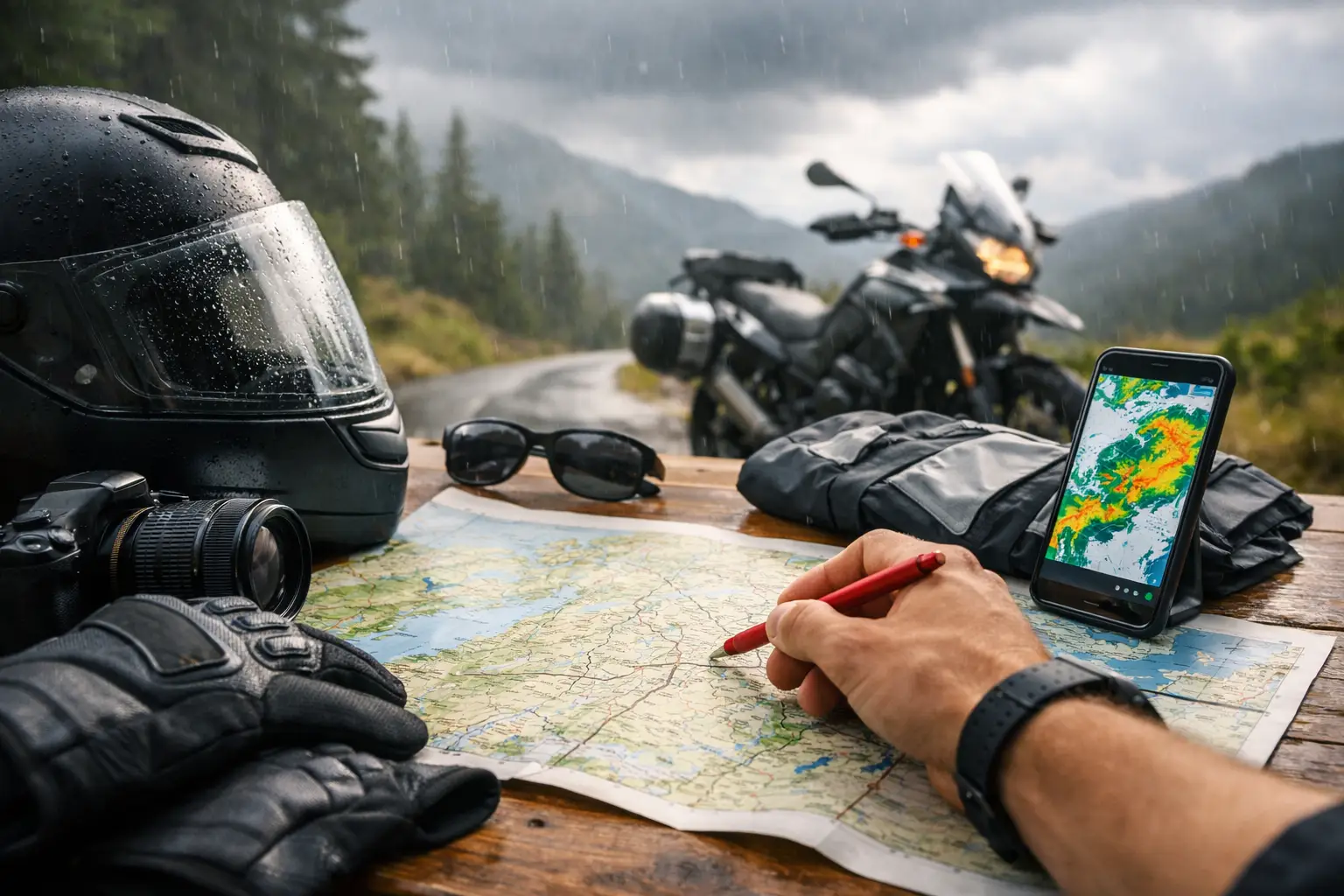
Rain aware motorcycle trip planning keeps a great route from turning risky. Learn how to read forecasts, choose roads, and build safer riding days well.
A clear Bay Area morning can turn into a wet, cold ride by the time you reach the redwoods, while a Southern California shower may pass before you finish coffee. That is why rain aware motorcycle trip planning is less about avoiding every drop and more about knowing where rain will be, when it will arrive, and what it changes on the road you chose.
For a rider with one free Saturday, the right call may be shifting a coastal loop two hours later. For a fly-and-ride visitor on a rental bike, it may mean skipping a foggy mountain pass in favor of lower-elevation curves. The goal is not to turn every trip into a weather drill. It is to protect the parts that make a ride great: good pavement, steady visibility, enough energy for the corners, and a route that still feels like an adventure.
Rain-Aware Motorcycle Trip Planning Starts With Timing
A daily forecast is only the first layer. “Rain likely” across an entire region tells you almost nothing about whether your 9 a.m. canyon departure is dry, whether a storm reaches the pass at noon, or whether the pavement gets its first wetting after weeks of dry weather.
Build the day around an hourly forecast and live radar, then match those conditions to your actual route timeline. Check the start point, the high point, the farthest turnaround point, and the destination. On a multi-day ride, do the same for every overnight stop and any pass, desert stretch, or coastal section that sits between them.
A route can be dry at breakfast and wet at the overlook two hours later. Elevation often explains the mismatch. A 60-degree valley can lead to 45-degree rain, fog, and standing water on a ridgeline. Near the Pacific, marine layers can keep shaded pavement damp long after inland roads dry out. In the Southwest, a sunny forecast does not rule out a fast afternoon cell that makes desert runoff crossings a bad bet.
The useful question is not, “Will it rain?” Ask, “What surface will I be riding at 11:30, and what is my exit if conditions change?”
Choose Routes With a Weather Escape Plan
The best rainy-day route is rarely the same as the best blue-sky route. Tight twisties remain fun in light rain for a prepared, experienced rider, but they demand more attention and offer fewer easy turnaround options. A scenic route with towns, fuel, covered stops, and parallel highways gives you choices when weather moves faster than expected.
Before you commit, identify a bailout point around the middle of the ride. It could be a state highway that returns to town, a lower-elevation road, or a café where you can wait out a cell. This matters most on remote routes where a “shortcut” may be narrow, unpaved, flooded, or closed without warning.
For example, a Big Sur-focused day may look perfect on a map, but rain changes the decision-making. Highway 1 can be spectacular in mist, yet wind, rockfall risk, closures, and low visibility can make a long coastal run a poor choice. A flexible itinerary leaves room for a shorter Monterey Peninsula loop, inland roads with better visibility, or a delayed departure after the weather clears.
On mountain routes, favor predictable pavement and lower grades when rain is expected. Avoid building a day around one remote pass with no alternate crossing. In heavy rain, low-water crossings, wash-prone roads, and steep unpaved connectors should be removed from the plan entirely. This is especially true on an unfamiliar rental motorcycle, where you may still be learning the brakes, clutch feel, tire condition, and luggage setup.
Read the Forecast Like a Rider, Not a Tourist
Precipitation chance is helpful, but it should not make the decision by itself. A 40% chance of brief showers is a very different ride from several hours of steady rain. Look at precipitation timing and intensity, wind, temperature, visibility, and recent weather.
Recent dry weather matters because the first rain can bring oil and grime to the surface. The opening 20 to 30 minutes of a shower are often slicker than a longer, steady rain that has washed the road clean. Intersections, gas stations, toll plazas, and urban approaches deserve extra caution because they collect more contaminants.
Wind deserves equal attention, especially on exposed coastlines, bridges, deserts, and mountain gaps. Rain on its own may be manageable, but rain plus crosswinds can turn a relaxed cruise into a tiring day. If the forecast includes gusts, reduce the route length and leave more time for breaks. A lighter, less experienced rider may be better off avoiding exposed roads altogether.
Temperature determines whether wet riding is simply inconvenient or a safety concern. At highway speed, 50 degrees and rain can chill a rider quickly, even with decent gear. Cold hands reduce fine control. A wet visor reduces contrast. Fatigue builds sooner. Plan shorter legs than you would on a warm, dry day.
A quick road-surface reality check
Not all wet pavement is equal. Fresh, textured asphalt with good drainage is usually predictable. Polished city pavement, painted lane markings, metal bridge grates, railroad tracks, tar snakes, wet leaves, and construction plates are not. Treat each as a low-grip surface: reduce lean angle, avoid abrupt inputs, and keep the bike as upright as possible while crossing.
Puddles carry their own uncertainty. They may be shallow, or they may hide a pothole, debris, or a broken edge. If you cannot see through the water, slow down before entering it and avoid following another vehicle so closely that its spray hides the road.
Adjust the Ride, Not Just Your Gear
Waterproof gear is essential, but it cannot fix an overly ambitious route. A proper rain plan changes pace, distance, departure time, and expectations.
Start with the motorcycle. Check tire tread, pressure, lights, brakes, and the condition of your visor before leaving. Rain exposes weak tires and poor visibility faster than almost any other riding condition. If you are renting, take two minutes at pickup to understand the traction-control and ride-mode settings. Do not experiment with unfamiliar electronics halfway through a storm.
Then make your riding inputs boring on purpose. Brake earlier and progressively. Roll on the throttle instead of snapping it open. Give yourself more following distance. Look farther through turns, because staring at shiny pavement directly in front of the wheel makes every patch feel worse. Smoothness is grip management.
Pack for access, not optimism. Keep rain gloves, a visor wipe, a neck gaiter, and a dry insulating layer where you can reach them without unpacking the whole bike. A waterproof outer layer that stays buried in a pannier is usually put on too late. If your gloves are soaked, a spare pair can make the last hour of the ride dramatically safer and more comfortable.
There are days when the smart move is to wait. A 45-minute radar gap can be enough to avoid the worst of a storm, particularly if the alternative is riding through lightning, near-freezing rain, flooding, or dense fog. Waiting is not losing a riding day. It is preserving the part of the day worth riding.
Build Two Versions of Every Weather-Sensitive Day
For weekend and vacation rides, create a primary route and a shorter fallback route before you leave. The primary route is for clearing weather and confident conditions. The fallback should still include a good road, a scenic stop, and a satisfying meal or destination, but it should stay closer to services and take less time.
A rider based in San Francisco might plan a full-day coastal and redwood loop, then keep a lower-mileage Marin alternative ready if rain settles over the coast. A visitor in the Smokies might trade a high-elevation scenic drive for a lower valley route when fog closes in. The fallback is not a consolation prize. Often, it becomes the better ride because you spend less time bracing against weather and more time enjoying the road.
This is where an AI-powered trip planner earns its place. CharterNow.ai can build around your dates, riding style, available time, skill level, and live weather insights, so the route is not just scenic on a map. It is shaped around the conditions you are likely to meet on the day.
Know When Rain Is a No-Go
Most light rain is manageable for a trained, properly equipped rider who adjusts accordingly. Some conditions are not worth negotiating. Do not ride into active lightning, flash-flood warnings, severe winds, freezing conditions, or visibility so poor that you cannot reliably see road markings and traffic.
Be equally honest about your own margin. If you are new to riding, tired from travel, on a bike you just rented, or carrying a passenger, your threshold should be more conservative. There is no prize for proving you can finish a route when the road has stopped being enjoyable.
Keep the weather plan simple enough to use: check the route timeline, carry the gear where you can reach it, and know exactly where you will turn back or wait. When the pavement dries and the clouds break, you will already be on a route that still deserves the ride. The road is waiting. Are you ready?