
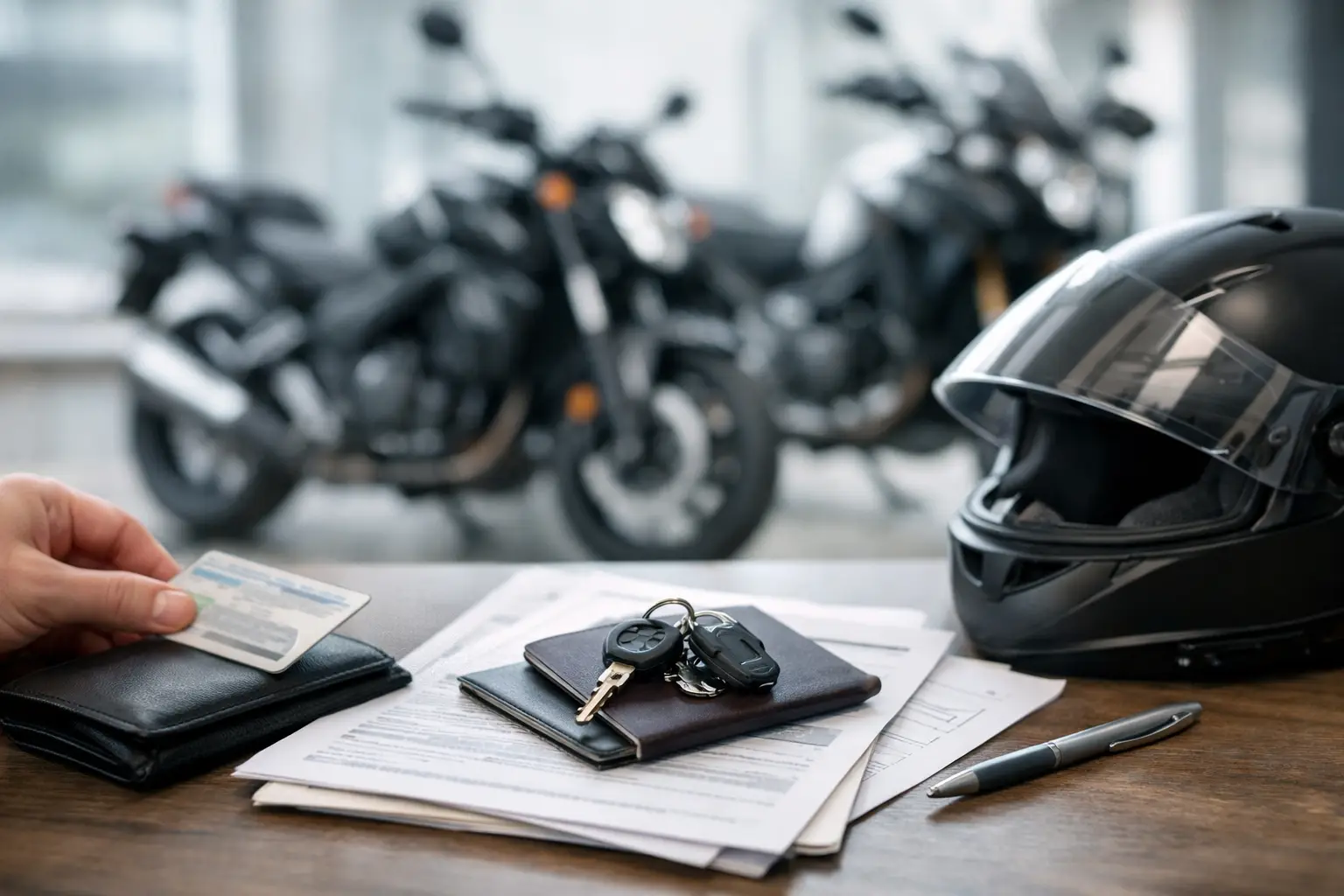
What documents for motorcycle rentals? Bring the right license, ID, payment card, and travel paperwork so pickup is quick and your ride starts on time.
You have finally landed near the Pacific Coast Highway, the Blue Ridge Parkway, or a desert loop outside Las Vegas. Your rental is booked, your helmet is packed, and the first twisty is calling. Then the counter agent asks for a motorcycle endorsement you do not have. Knowing what documents for motorcycle rentals are required before you travel keeps a great ride from ending in a parking-lot disappointment.
The short answer is simple: bring a valid motorcycle license, government-issued photo ID, and a credit card in the renter's name. But the details matter, especially for fly-and-ride travelers and international visitors. Rental policies vary by company, motorcycle category, rider age, and state, so treat the reservation confirmation as the final rulebook.
What documents for motorcycle rentals are required?
For most U.S. motorcycle rental pickups, you will need to show your original driver's license with a valid motorcycle endorsement or motorcycle license. A regular car license alone is usually not enough, even if you have years of experience riding abroad or own a bike at home.
You will also need a government-issued photo ID. For U.S. residents, your driver's license commonly covers both the identity and license requirements. International travelers should expect to present their passport as well as their home-country motorcycle license. The rental company needs to verify who you are, whether you are legally allowed to ride, and whether the person signing the agreement is the person taking the bike out.
Finally, bring a major credit card in your own name. Most rental operators place a security deposit or authorization hold on that card, often separate from the rental charge. A debit card, prepaid card, virtual card, or card belonging to a riding buddy may be declined even when it worked to make the online reservation.
Your motorcycle license is the non-negotiable document
In the U.S., the correct credential is usually an M endorsement on a state driver's license or a separate motorcycle-only license. Check that it is current and physically in your possession. A photo of a license on your phone is useful as a backup, but it rarely replaces the original at pickup.
Do not assume a scooter exception will help. Some states treat lower-displacement scooters differently for licensing, while rental companies may still require a full motorcycle endorsement for every two-wheeled rental. If you are booking a large touring bike, adventure bike, or performance-oriented machine, the company may also have minimum age or experience requirements.
A learner's permit can be a gray area. It may be legal for supervised practice where it was issued, but rental companies commonly refuse permits because they carry restrictions such as daylight-only riding, no passengers, or no freeway use. Ask before booking, not at the counter.
International riders may need an IDP
If your home-country motorcycle license is in English and clearly shows that you are licensed for motorcycles, some U.S. rental companies will accept it with your passport. If it is not in English, an International Driving Permit, or IDP, is frequently required.
An IDP is not a driver's license. It is a standardized translation that must be carried alongside your valid home-country license. It does not give you motorcycle privileges that your original license does not already show. Obtain it in your home country before departure; it is not something to count on finding after you arrive in the U.S.
Even with an English-language license, an IDP can make a cross-border rental easier. It gives the counter staff and, if needed, law enforcement a clearer read on your credentials. But acceptance is still up to the rental company's policy, so get written confirmation if your documentation is unusual.
The payment card and deposit catch riders off guard
The credit card requirement is about more than paying for the bike. It is how the rental business secures a deposit for theft, damage, late returns, tolls, and other charges. The available credit limit must be high enough for both the rental total and the hold.
Before your trip, ask three direct questions: What is the deposit amount? Is the hold placed per motorcycle? How long can the bank take to release it after return? A $300 weekend rental can still require a much larger available balance when the keys change hands.
Make sure the card name matches your license and reservation. If your partner paid for the booking but you will ride, bring a qualifying card in your name. This is one of the most common reasons a fully planned motorcycle day gets delayed.
Insurance paperwork: bring proof, but read the rental agreement
Your personal motorcycle insurance may extend to a rental, but never assume it does. Some policies cover only motorcycles you own. Others include liability but exclude damage to a rented bike, roadside assistance, gear, or loss-of-use charges while the motorcycle is being repaired.
Bring your insurance card and save your insurer's policy details offline. If you plan to decline the rental company's coverage, call your insurer first and ask specifically about motorcycle rentals in the state where you will ride. Credit card rental protection is even less predictable: many cards exclude motorcycles altogether.
The rental agreement will spell out the coverage options, deductible, exclusions, and responsibilities after a crash or theft. Read the parts about unpaved roads, water crossings, off-road use, passenger coverage, towing, and geographic boundaries. An adventure bike does not automatically mean you are insured to take it down every forest road.
For a short vacation ride, the rental company's protection can be worth the added cost when your own coverage is limited. For a frequent renter with specialized motorcycle coverage, declining duplicative protection may make sense. It depends on the bike's value, the deductible you can comfortably absorb, and how much uncertainty you are willing to carry into a new riding area.
Extra documents that can save the day
The core documents get you approved. A few additional items can make the rest of the trip less stressful:
-
Your reservation confirmation, including pickup time, location, motorcycle class, and any pre-selected coverage.
-
A printed or offline copy of the rental agreement and emergency contact number.
-
Proof of insurance, policy number, and roadside-assistance details.
-
Your passport, return-travel details, and IDP if you are visiting from another country.
-
A second form of payment or backup card, kept separately from your wallet.
These are not always mandatory, but they are practical. Airport Wi-Fi fails, phones run out of battery, and rental counters can be busy on a Friday afternoon. Paper or offline access gives you options when you need them.
Documents are only part of being rental-ready
A valid license gets you to the checkout screen, but it does not guarantee the bike is a good fit. Rental staff may ask about your experience, height, recent riding time, and comfort with the motorcycle you selected. Be honest. A loaded bagger in city traffic, a tall adventure bike on uneven pavement, and a powerful sport bike on unfamiliar mountain roads each demand different skills.
Use pickup time to inspect the motorcycle with the agent. Photograph existing scratches, luggage marks, wheels, tires, windscreen, and any accessories. Confirm fuel level, required fuel grade, tire condition, emergency procedures, return time, and where the registration and insurance documents are stored on the bike. You should carry those vehicle documents while riding, but the rental company supplies them.
This is also the moment to look at the route with real conditions in mind. A sunny coastal plan can become cold and foggy by late afternoon. A mountain pass that looks perfect on a map may have rain, construction, or a temperature swing that changes the ride entirely. CharterNow.ai can help riders match a rental-friendly route to their skill level, available time, preferred bike, and live weather before the first mile.
A quick pre-pickup check
The night before pickup, put your original motorcycle license, photo ID or passport, qualifying credit card, insurance information, reservation confirmation, and IDP if needed in one travel pouch. Then confirm the rental location's hours and your arrival plan. A delayed flight is easier to solve with a phone call than with a locked rental office.
Also pack the gear you need to ride legally and comfortably. Helmet rules differ by state, and rental helmet availability varies. Bring eye protection, gloves, a jacket, and layers even for warm-weather destinations. Documentation gets you the keys; good preparation lets you enjoy the road once you have them.
The best rental pickup feels almost boring: credentials checked, deposit approved, walk-around complete, route loaded, and wheels rolling. Handle the paperwork before the trip, then save your attention for the curves, the overlooks, and the roads you came to ride.