
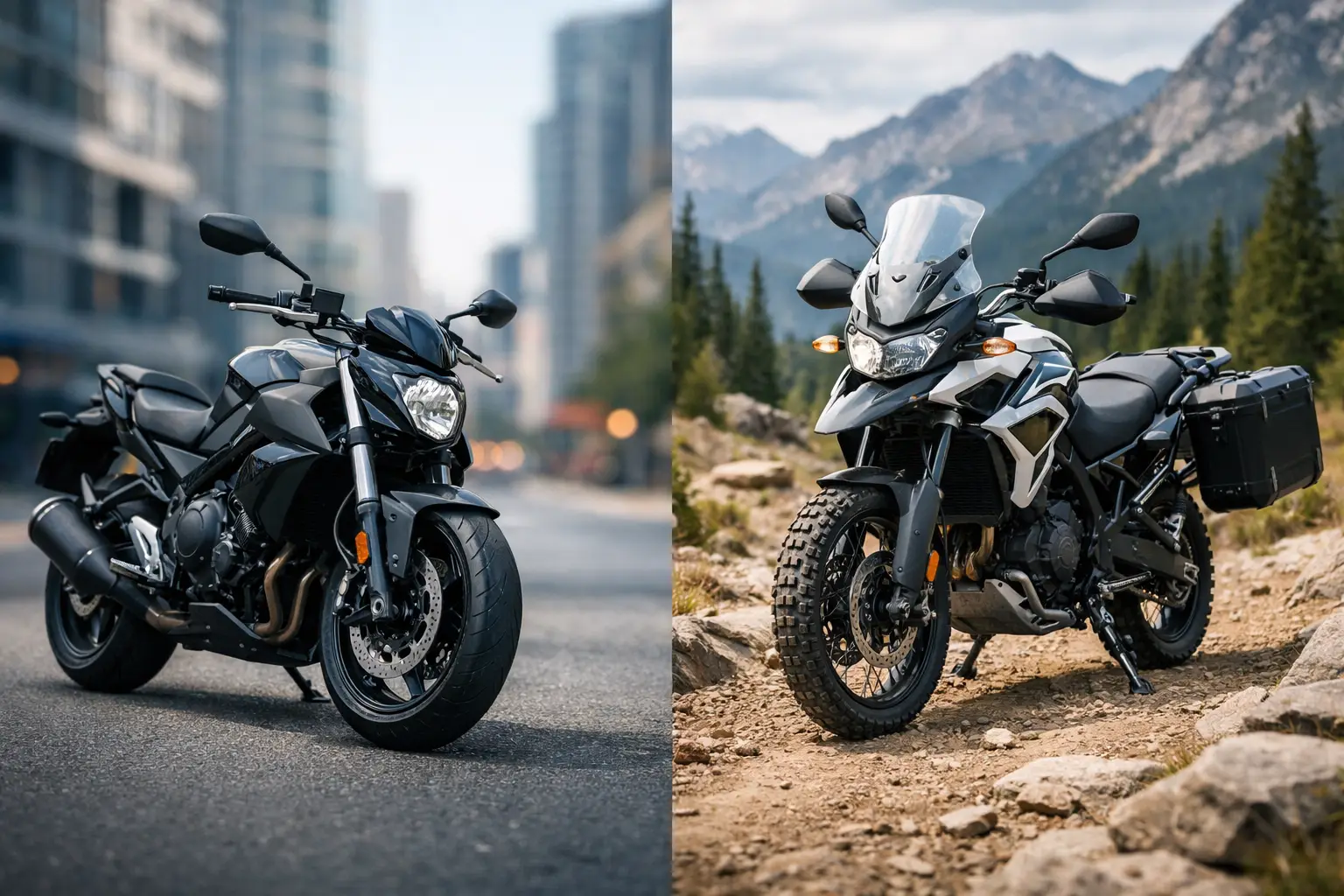
Street versus adventure motorcycle choices shape every mile. Compare comfort, handling, luggage, pavement, and dirt capability before planning your ride.
A tight set of California twisties can make a street bike feel like the obvious answer. Then you spot a graded forest road leading to a fire lookout, or a rain-slick turnout with a broken shoulder, and the street versus adventure motorcycle question gets more interesting. The right bike is not the one with the most categories checked. It is the one that makes your actual trip feel easy, capable, and fun.
For riders planning a weekend loop, a fly-and-ride vacation, or a rental-based road trip, the decision usually comes down to where the miles happen. Pavement quality, passenger plans, luggage, weather, rider experience, and how badly you want to follow that unmarked road all matter more than a spec-sheet debate.
Street versus adventure motorcycle: the real difference
A street motorcycle is built around pavement performance. That can mean a naked bike, sport bike, cruiser, sport tourer, or standard. The category is broad, but the shared idea is clear: lower ride height, road-focused tires, quicker steering, and a chassis designed to communicate what the front tire is doing on asphalt.
An adventure motorcycle, often called an ADV, is designed to keep going after the pavement gets questionable. It typically has longer suspension travel, more ground clearance, a taller stance, an upright riding position, and wheels and tires that tolerate rough surfaces better. Some ADVs are genuinely capable off-road machines. Others are long-distance road tourers with adventure styling and enough clearance for gravel pullouts and poorly maintained access roads.
That last distinction matters. A large adventure bike on 90/10 road tires is not automatically better in deep sand or rocky trails than a smaller dual-sport. Likewise, a street bike with luggage and a comfortable seat may be a far better cross-country machine than a lightweight ADV with a narrow saddle. Shop the intended ride, not the badge on the tank.
How each bike feels on a real route
On clean pavement, a street bike generally feels more planted and precise. Its lower center of gravity helps at stoplights, in parking lots, and through fast direction changes. Road tires warm up quickly, brake confidently on pavement, and give clearer feedback when you lean into a familiar set of curves. If your dream day is Angeles Crest Highway, the Santa Monica Mountains, the Blue Ridge Parkway, or a smooth coastal run to Big Sur, a street-focused motorcycle delivers a connected, direct feel that is hard to beat.
Adventure bikes trade some of that sharpness for range and composure. Their longer suspension absorbs frost heaves, potholes, patched pavement, bridge seams, and washboard gravel without making every impact a full-body event. The upright position gives you a wider view through traffic and over roadside scenery. Standing on the pegs is also an option when the road turns rough, which can save your back and improve control.
The cost is height and mass. Many ADVs are tall enough that newer or shorter riders can only get one foot firmly down at a stop. That becomes tiring on an off-camber turnout, a loose gravel gas station, or a fully loaded bike at the end of a long day. A street bike may be less forgiving when pavement disappears, but it is often less intimidating every time you stop.
Tires tell the truth
Tires reveal what a motorcycle is really prepared to do. A street bike on sport-touring tires can handle an occasional hard-packed dirt road if you slow down, stay loose on the bars, and avoid sudden braking. It is not a reason to plan 30 miles of gravel, especially if rain is likely.
An ADV fitted with 80/20 tires - roughly 80 percent pavement and 20 percent dirt - is excellent for mixed-surface travel. It can cruise a mountain highway in the morning and take a maintained gravel road to a viewpoint after lunch. More aggressive 50/50 or knobby tires add bite off pavement but can feel louder, wear faster, and give up some wet-road confidence and cornering smoothness.
For a rental trip, inspect the tires rather than assuming the model name tells the whole story. The same adventure motorcycle can be a pavement-focused tourer or a loose-surface explorer depending on what is mounted.
Choose based on the ride you will actually take
A street motorcycle is usually the smarter pick when your route is overwhelmingly paved, your priority is cornering, or you want a lower, lighter-feeling machine. It also makes sense for riders who are returning after time away, riders navigating busy cities, and couples who want predictable road manners without the tall-seat learning curve.
An adventure motorcycle earns its keep when the route includes uncertain pavement, elevation changes, remote overlooks, national forest roads, or weather that may turn a perfectly good road into a messy one. It is especially useful on trips where you do not want to reroute simply because the final few miles are broken pavement or smooth gravel.
Think about your day in percentages. If you expect 95 percent pavement and five percent well-maintained dirt, either bike can work. The street bike will be more rewarding on the paved sections, while the ADV reduces anxiety when conditions deteriorate. If the plan is 70 percent pavement and 30 percent unpaved roads, an ADV is the clearer choice. Once the surface becomes technical - deep ruts, sustained sand, loose rock, mud, or steep rocky climbs - a big ADV may still be the wrong tool. A lighter dual-sport or a different route could be safer and more enjoyable.
Comfort, luggage, and the long-day factor
Adventure bikes have a reputation for comfort because their seating position is upright and their suspension is generous. That reputation is often deserved, particularly on long, imperfect roads. Wide handlebars reduce the cramped feeling some riders get on sportier machines, and many ADVs have practical mounting points for panniers, top cases, and soft luggage.
But comfort is personal. Wind protection can create helmet buffeting for taller riders. Tall, flat seats can become uncomfortable after several hours. The broad front end of some ADVs catches crosswinds on exposed desert roads or coastal bridges. A street-oriented sport tourer may offer better wind management, a lower seat, heated grips, cruise control, and superior passenger comfort for an all-pavement vacation.
Do not overlook fuel range. Remote routes in the Southwest, mountain regions, and parts of the West can put real distance between fuel stops. Many ADVs carry enough fuel for long legs, but not all of them do. Check the usable range for the motorcycle, then leave a margin rather than treating the published tank size as a promise.
Weather changes the answer
Rain does not automatically favor an adventure bike, but rough weather makes its strengths more valuable. Extra suspension travel and a relaxed riding position can help when roads are patched, wet, or littered with debris after a storm. Ground clearance is useful around flooded shoulders and uneven pullouts.
Still, traction comes from tires and rider inputs, not the word “adventure” on the side panel. On wet pavement, smooth throttle control, longer following distances, gentle braking, and tires in good condition matter more than motorcycle category. In cold mountain weather, an ADV’s windscreen and heated accessories can be welcome, while a fully faired street tourer may provide even better protection.
Before committing to a mountain pass or a dirt detour, check live weather at the elevations you will actually ride. A warm valley forecast can hide cold rain, fog, or wind near the ridge. Snowmelt and recent storms can also turn easy gravel into slippery clay.
A better way to plan your motorcycle choice
Start with the route rather than the motorcycle. Mark the roads you genuinely want to ride, the places you need to reach, and the hours you have available. Then ask practical questions: Is every road paved? Are there long interstate transfers? Will you carry camping gear? Is a passenger joining? Are you comfortable managing a tall bike on loose surfaces? Is there a backup route if weather closes a pass?
For travelers, this is where a purpose-built trip plan saves time. CharterNow.ai can build a motorcycle route around your dates, riding level, preferred bike style, ride duration, weather, and goals, then help surface rental options that fit the plan. That is more useful than choosing an ADV because it looks ready for adventure, then discovering your itinerary is 400 miles of pavement and hotel parking lots.
A great motorcycle trip should leave room for the unexpected without asking you to wrestle the wrong machine all day. Pick the street bike when the road itself is the destination. Pick the adventure bike when getting beyond the perfect road is part of the point. Then load the route, watch the weather, and ride toward the turn you would have skipped before.